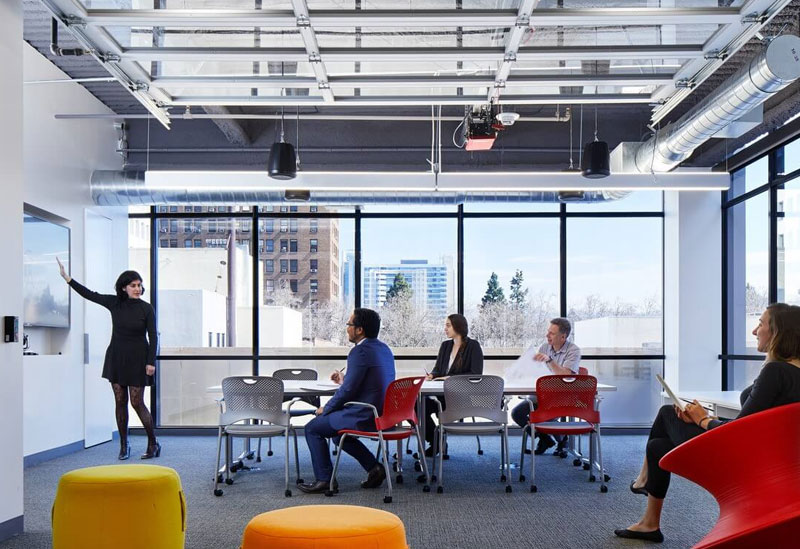
For years, workplace design was treated like background noise, something the facilities team quietly handled while everyone else focused on “real” strategy.
That mindset is now quietly killing retention, creativity, and competitive advantage.
In a world of hybrid work and brutal talent competition, the best CHROs have stopped outsourcing the office. They’ve claimed it as one of their most powerful people levers.
Because the way your space looks, feels, and functions sends a louder message about culture than any all-hands or values poster ever could.
Get it right, and you give them a reason to stay, focus, collaborate, and bring their best ideas.
Get it wrong, and no amount of perks or pay can fix the quiet resentment of working in a space that feels like it was designed for robots, not humans.
Here’s how the sharpest CHROs are doing it, and why you should too.
Until recently, most organizations defined employee well-being through health insurance, gym memberships, and leave policies. While these benefits matter, they represent a transactional approach that misses the deeper opportunity. Industry experts emphasize that the real shift involves recognizing how workplace design influences stress, focus, and emotional balance, the less visible aspects of daily employee experience.
Leading people strategists argue that the environment created for employees must go beyond basics and address nuanced, invisible aspects of their day-to-day experience. Natural light, ergonomic furniture, and acoustic control are no longer differentiators. The next frontier of well-being lies in design that enables choice and reflects individual needs.
More importantly, the office has become the single most visible expression of your culture. You can write values on a wall, but people believe them when they feel them in the space:
Workplace design does more than house employees. Research shows that the physical environment isn't just where work happens; it's a living artifact of organizational culture. While values may be declared on websites, they become authentic when embedded in physical spaces.
This represents a strategic imperative for CHROs. When employees see values physically manifested around them, they internalize culture not as abstract ideas but as lived experiences. For example:
Workplace design has undergone dramatic transformation. According to Gensler Global Workplace Survey 2025, work has evolved significantly over the past several decades, with each period defined by specific economic and cultural shifts. Historically, the largest influences on workplace design were economic conditions and technological evolution. Traditional offices were designed around fixed requirements, with standardized cubicles and hierarchical layouts reflecting the organizational structures of the time.
However, the paradigm has shifted. Organizations now design not for what's required, but for what's possible. After several years of hybrid work experimentation, companies now have real data showing that while technology enables remote work, the physical workplace matters more than ever. Where employees work affects their engagement, productivity, and collaboration levels.
The hybrid work experiment has yielded critical insights. According to Gensler's Global Workplace Survey 2025, organizations now understand the importance of in-person work and how workplaces can better support all work forms for individuals and teams. This data-driven understanding allows CHROs to make strategic decisions about workplace design investments.
Looking forward, workplace design will be characterized by continuous evolution rather than fixed endpoints. CHROs must design spaces that adapt and iterate throughout their lifespan, responding to changing workforce needs, technological advances, and business priorities. The future workplace will balance human-centric design with technological integration, creating environments that enhance distinctly human capabilities while leveraging digital tools for productivity.
Workplace design is a powerful tool to attract, engage, and retain top performers. The following three core principles help CHROs create environments where employees thrive and businesses succeed.
The fundamental shift in workplace design thinking involves viewing employees as human beings rather than human resources. Progressive organizations recognize that for too long, people have been treated as "human resources" when they should be seen as human beings first.
This human-centric approach means:
Creating Choice and Agency
These interventions may appear subtle but are powerful because they give employees agency over their energy and emotional states. Employees expect a holistic focus on them as individuals, their sense of belonging, and their need to feel seen as whole persons.
Modern workplace design prioritizes experience through several key elements:
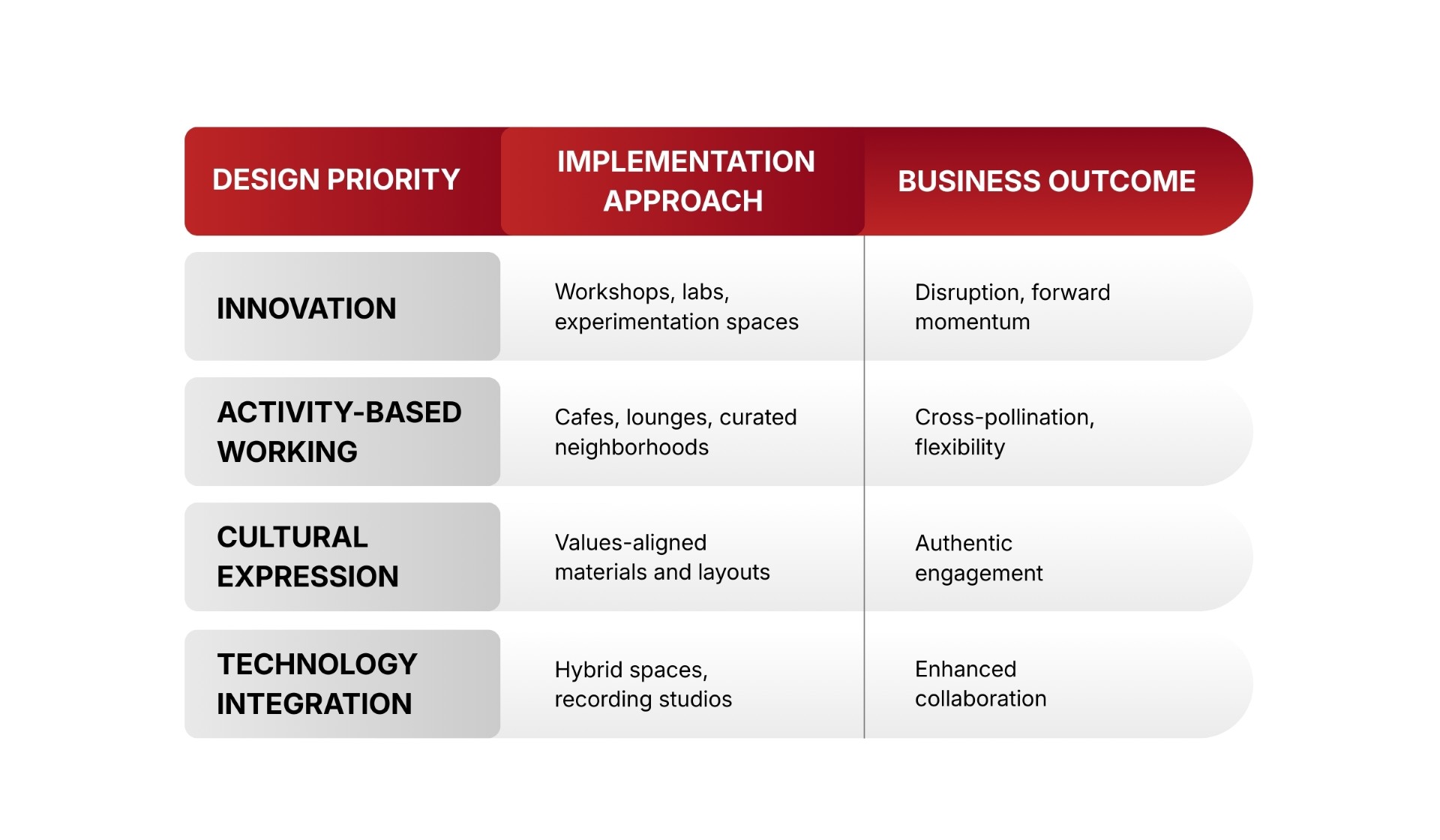
Organizations recognize that the world changes rapidly, requiring responses that adapt rather than remain fixed. This drives the design of adaptable spaces, facilitating experimentation, prototyping, and learning. Workshops and laboratories increasingly replace boardrooms as places where innovation takes shape.
CHROs occupy a unique position at the intersection of business needs and employee priorities, making them central to workplace design processes. The task involves viewing the office not as a static construction project but as a "living system" that evolves with the organization.
The best workplace design outcomes come from close collaboration between three key stakeholders:
HR Contributions:
Business Leader Input:
Workplace Strategist Expertise:
Without this partnership, organizations risk building spaces that look impressive but fail to serve their people or purpose.
Strategic workplace design requires focusing on space purpose rather than aesthetics. CHROs must ask critical questions:
Research indicates that desks and chairs are just the starting point. The real aim involves creating an ecosystem fostering collaboration, supporting well-being, and driving innovation.
The next decade of workplace design will be defined by human-centric principles that counterbalances technology's growing influence. A paradox is emerging as artificial intelligence becomes central to work, organizations' strategic advantage lies in distinctly human capabilities.
Workplace strategists note that AI will democratize intelligence, making everyone smarter, faster, and more productive. In that context, performance metrics shift from routine tasks to skills like emotional intelligence, creativity, and critical thinking.
The physical workplace must play a new role as a social connector offsetting digital tools' isolation. Offices should become places to:
Forward-thinking organizations understand that to deliver a "Results Revolution," they must build environments where employees can thrive, learn, and continually upskill for jobs that don't even exist yet. The workplace has become an essential tool for preparing people for future work and helping them navigate the Fourth Industrial Revolution's constant ambiguities and changes.
Some organizations already realize what's called a "Connection Dividend"—the measurable business benefits from designing spaces to intentionally foster social bonds. This transcends well-appointed offices, instead creating workplaces directly fueling innovation, collaboration, and belonging.
The ways we engage with offices change with each technological advancement, blurring space, time, and collaboration method boundaries. Forward-thinking CHROs require strategic integration of digital/physical specialty spaces for activations fostering innovation and partnership.
Future-Ready Technology Spaces:
Workplaces equipped with these spaces advance organizational missions faster and draw more workers to offices. However, change rates make predicting technological innovations just around the corner impossible.
Rather than designing specific technologies, CHROs should create easily adaptable frameworks accommodating the widest range of future experiences. This means:
Great workplaces are built step by step. This section gives CHROs a clear, actionable plan to create spaces that boost engagement, attract talent, and drive results.
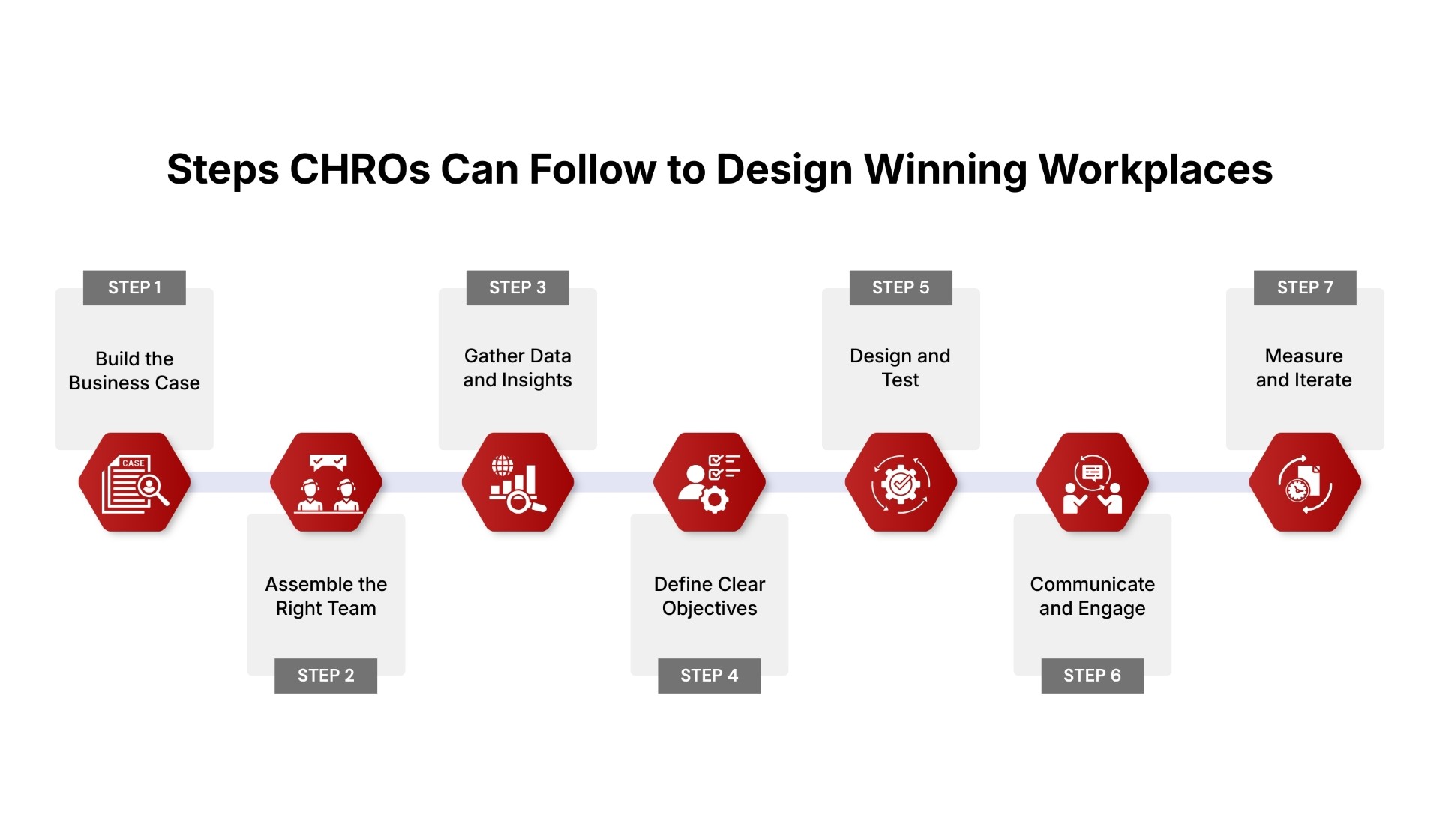
Articulate workplace design's strategic value by:
Create cross-functional workplace design committees including:
Collect comprehensive information through:
Establish what success looks like:
Implement iteratively through:
Ensure stakeholder buy-in by:
Treat workplace design as a living system:
The future of work no longer has a fixed objective. CHROs must design spaces that continue to iterate throughout their lifespan. The possibilities are endless, but success requires treating workplace design as what it truly is: a core people strategy.
By elevating workplace design from a facilities concern to a strategic priority, CHROs can:
Leading HR strategists emphasize that workplace design should be seen not as a facilities project, but as a core people strategy. By becoming the architects of not just people policies but also the spaces where people work, CHROs position themselves and their organizations for sustained success in the evolving world of work.
The question is no longer whether workplace design matters, it's whether your organization will treat it strategically before your competitors do.
This website uses cookies to enhance website functionalities and improve your online experience. By browsing this website, you agree to the use of cookies as outlined in our privacy policy .