In today's interconnected world, talent acquisition is evolving beyond borders, necessitating innovative, tailored approaches. Organizations worldwide face intense competition for specialized skills while navigating complex regulatory environments, varied compensation expectations, and diverse cultural norms across international markets. Sourcing and retaining talent internationally is now a competitive necessity, not just for large multinationals.
The driving forces behind this transformation include worldwide competition for scarce expertise and the growing mobility of in-demand skills. Employees expect location flexibility, and employers focus more on skills than traditional qualifications. Many business leaders anticipate filling significant portions of future roles through international recruitment channels.
Simply scaling domestic hiring practices across borders rarely produces the desired outcomes. The challenge extends beyond competing for talent to encompass managing different regulations, pay structures, and cultural expectations. Organizations require strategic frameworks that foster growth while safeguarding business interests through compliant, sustainable international talent acquisition models.
Global talent acquisition encompasses the processes of designing, building, and managing cross-border workforce structures to meet current and future skill requirements. While traditional recruiting focuses on filling immediate vacancies, global recruitment strategy centers on building sustainable international talent pipelines that provide competitive advantages.
This strategic approach includes several critical components. Organizations must identify where specific skills concentrate worldwide while understanding how talent moves between countries and regions. Staying current with geopolitical trends and regulations impacting hiring decisions becomes essential. Using local market data to inform compensation, benefits, and hiring processes ensures competitive positioning in target markets.
Crucially, international recruiting shifts focus from vacancy filling to enabling market entry, driving market share growth, and mitigating operational risks. This transformation requires different mindsets, capabilities, and operational frameworks compared to domestic hiring programs.
Historically, only large multinationals invested significantly in global talent acquisition infrastructure. The contemporary business environment has expanded this requirement to additional organizational categories that cannot achieve sustainable growth without international hiring capabilities.
Here are the key types of organizations that now need formal global talent strategies:
Running international talent acquisition as a strategic function requires clear differentiation from domestic hiring practices. Teams frequently attempt forcing global processes into local frameworks, creating inefficiencies and missed opportunities.
Here are the key differences between global and local talent acquisition:
Global: Emphasizes long-term workforce planning, driven by skill scarcity and future strategic needs
Local: Focuses on filling immediate vacancies through transactional, short-term approaches
Global: Involves multi-country market research, offshore capability building, and mitigation of Permanent Establishment risks
Local: Operates within a single national labor market with tactical execution constrained by set budgets and time-to-hire targets
Global: Targets diverse, worldwide pools to secure highly specialized or rare skills, while building long-term pipelines in emerging technology and talent hubs
Local: Works with smaller, more familiar regional pools where success relies on local networks and strong employer value propositions
Global: Requires optimized total rewards with location-based pay tiers, accounting for cost-of-living variations, currency fluctuations, and international competitiveness
Local: Centers on regional market rates and benchmarks to ensure competitiveness within a single geography
Global: Must navigate complex international regulations, tax implications, and cross-border compliance risks
Local: Primarily deals with national labor laws and localized compliance requirements
Shifting to strategic global talent hiring models introduces operational and compliance risks ranging from managing multiple legal frameworks to establishing fair, sustainable pay structures in volatile markets. Without centralized, systematic management, these challenges create long time-to-hire periods, inconsistent candidate experiences, reputational damage, and serious legal or data privacy exposure.
Every new country introduces different labor laws, termination rules, working hours, mandatory benefits, and documentation standards. Without structured approaches, organizations risk noncompliance, lawsuits, and financial penalties.
Best practices:
Entity registration, local payroll setup, visa sponsorship, and cross-functional approvals significantly extend hiring timelines, particularly outside North America and the European Union. Top candidates often accept faster offers from local competitors during these delays.
Best practices:
Setting fair, competitive salary ranges across markets presents significant difficulties. Relying on home-country pay scales results in either underpayment causing brand damage or overpayment inflating global cost bases through salary exporting.
Best practices:
Hiring in new countries can inadvertently create taxable corporate presence, especially when employing senior leaders or sales roles. This triggers unexpected tax liabilities and administrative overhead requiring careful management.
Best practices:
Central employee value propositions working in one region may fail or backfire elsewhere. Communication styles, hierarchy expectations, and work-life balance views vary widely. Direct feedback appreciated in Dutch workplaces might be considered disrespectful in some Asian cultures.
Best practices:
Multiple applicant tracking systems, payroll providers, and HRIS platforms without integration make managing compliance, maintaining data integrity, and obtaining unified views of global headcount and costs extremely challenging.
Best practices:
Addressing these challenges systematically enables organizations to build truly strategic global talent acquisition functions that are compliant, efficient, and competitive in a borderless talent market.
Translating challenges and team requirements into practical, repeatable strategies requires systematic approaches. The following steps provide frameworks for aligning and scaling recruitment operations with global business goals.
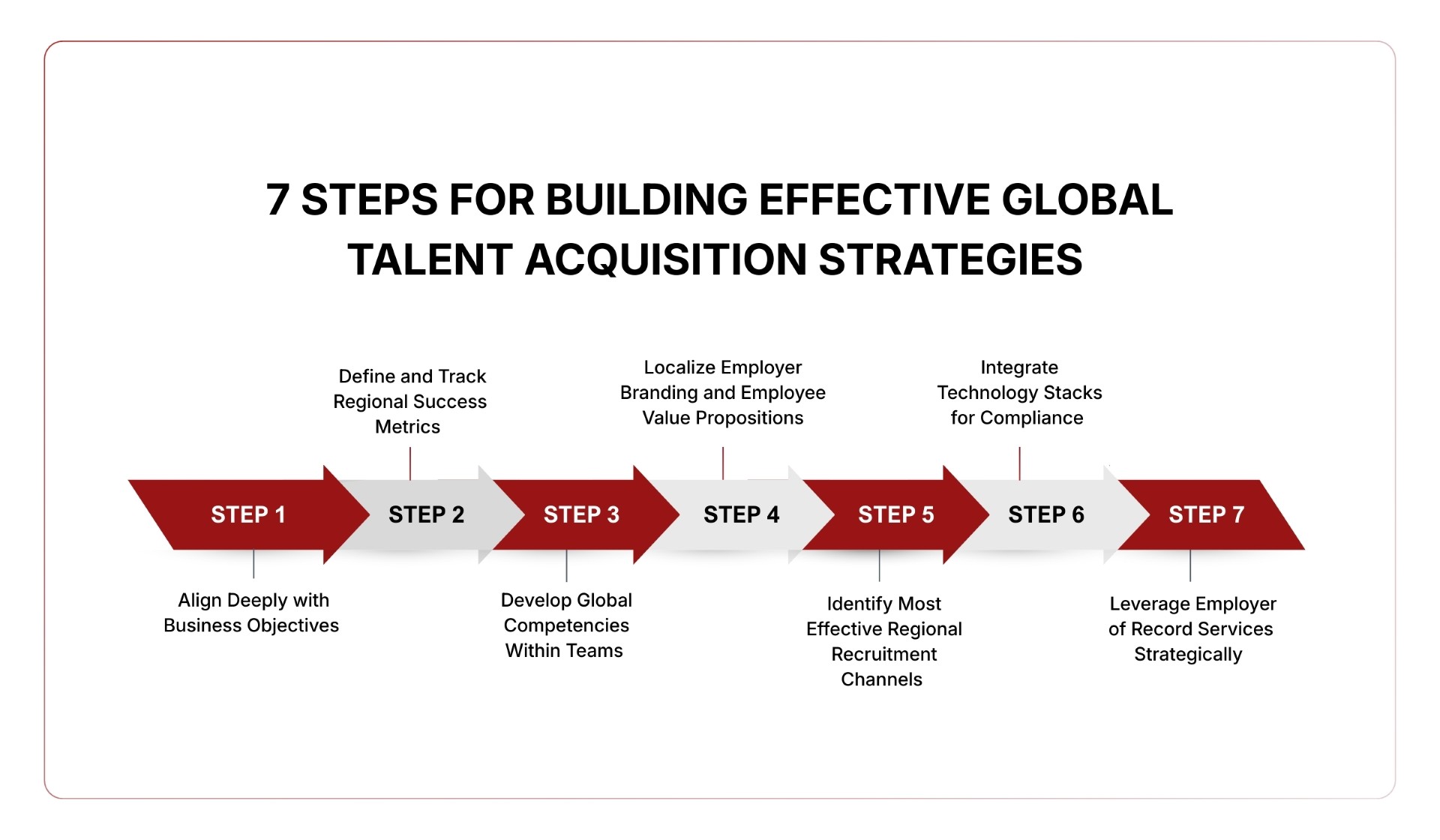
Talent hiring cannot operate independently from business strategy. Begin by exploring organizational expansion roadmaps in detail, clarifying business models for each target market. Organizations must align hiring models appropriately, using EORs and flexible arrangements for speed-to-market priorities while establishing local entities and permanent roles for long-term intellectual property development.
Risk appetite assessment proves critical. Talent recruiting decisions must align with organizational tolerance for permanent establishment, labor, and compliance risks. Actions include building quarterly global workforce plans with finance and business leaders, deciding upfront between entity, EOR, or contractor models for each new market, and documenting which roles can or cannot be hired until legal structures exist.
Project44, a high-growth supply chain visibility platform, needed to hire 129 employees across 25 countries while maintaining compliance. By partnering with EOR provider Deel, the company created legal firewalls where Deel acted as local employer managing payroll and filings while Project44 focused on building its global team and customer reach.
Traditional metrics like time-to-hire fail to tell complete stories in global contexts. More sophisticated key performance indicators become necessary for effective international talent hiring management.
Priority metrics include:
Implementation requires creating global TA dashboards showing performance by region rather than only globally, running quarterly reviews with regional HR and business leaders discussing TA metrics and root causes, and using data to decide whether to scale, pause, or redesign hiring in specific markets.
A global life sciences company with 40,000 employees struggled with inconsistent recruitment processes across countries. By partnering with Randstad Sourceright and implementing global program structures with centralized KPIs, the company achieved consistent recruitment standards across 28 countries while maintaining strong local execution and hiring more than 5,000 employees annually.
Organizations need new mindsets beyond domestic talent acquisition for global success. Teams require specific skill development across multiple dimensions.
Cultural Intelligence (CQ) enables understanding of cultural norms, communication styles, and expectations across markets. Digital fluency involves using modern sourcing tools, assessment platforms, and automation technologies effectively. Bias awareness helps design and run fair interviews across cultures without unconscious prejudice.
Training initiatives should cover CV and resume conventions by country, standardized interview guides and scorecards with cultural bias training, and structured interviews with validated assessments minimizing reliance on intuition.
Unilever, employing people from more than 100 nations, prioritizes Cultural Intelligence development among its workforce. Through comprehensive training initiatives enhancing cultural understanding and sensitivity, Unilever equips employees with effective communication capabilities, positive relationship building across cultures, and ability to work effectively in cross-cultural teams leveraging diverse perspectives for innovation.
Strong global employer brands build on coherent cores with thoughtful localization. One-size-fits-all messaging fails across diverse markets. Hustle culture narratives working in Silicon Valley can alienate candidates in regions prioritizing stability and work-life balance.
Organizations should define core EVP pillars such as innovation, impact, and growth, then localize execution by adapting messaging, visuals, and benefits to local values and motivators. Implementation involves running local talent market research or focus groups understanding what candidates value in each region, providing local TA teams with brand toolkits including adaptable templates, and aligning employer branding with total rewards beyond marketing copy.
Coca-Cola HBC, operating across 28 countries on three continents, needed to refine its Employee Value Proposition and scale its employer brand globally. The company undertook detailed research to lock in its core value proposition, then worked with Haiilo to enable extensive localization and customization. By granting local administrators day-to-day administrative rights while maintaining central governance over core pillars, Coca-Cola HBC reached 4 million people and generated 100,000 USD in visibility on social media in eight months with a 94% engagement rate.
Channel strategy proves highly location-specific. LinkedIn may dominate in some regions, but organizations need Xing in DACH markets, WeChat in China, or niche boards in Latin America. Mapping digital hangouts identifies which platforms target personas to use in each region.
Organizations should diversify sourcing spend balancing global platforms with local job boards, communities, and events. Building channel matrices by role type and region with performance data including applications, quality, and cost per hire enables informed decisions. Testing and refining new local channels quarterly with co-created channel plans involving local leaders and recruiters improve effectiveness.
A customer of House of Shipping sought rapid global expansion requiring over 100 specialized roles across diverse regions including UAE, Turkey, China, and South Korea. Despite strong brand recognition in their home market, they faced significant hurdles recruiting locally due to low brand recognition in new territories. By implementing end-to-end global recruitment strategy integrating both international and local job portals along with social media, they successfully filled over 100 roles across 15 countries.
Fragmented technology makes global talent acquisition slow, risky, and opaque. Organizations must eliminate fragmentation by choosing applicant tracking systems supporting multi-region compliance while integrating with HRIS, payroll, and EOR platforms.
Ensuring data integrity requires aiming for single sources of truth for headcount, vacancies, and TA performance. Investing in middleware where needed connects legacy or local systems through integration tools.
Actions include mapping all tools used in recruitment across regions identifying duplicate or non-compliant systems, prioritizing integration projects improving compliance and reporting, and using role-based access control protecting sensitive candidate data.
G4S, a leading global security group, faced challenges with highly decentralized, paper-based onboarding across numerous countries. This fragmentation created inefficiency, poor candidate experience, and major compliance risk. By implementing centralized digital ATS platform provided by Tribepad, G4S enabled instantaneous document changes across all global operations with time and IP-stamping for legally required forms, reducing in-person onboarding from two hours to 20 minutes.
EOR providers function as powerful levers for agile, low-risk expansion. Organizations can use EORs to hire full-time employees in markets where legal entities do not yet exist, test and learn to validate market potential and talent availability before committing to permanent entities, and plan transitions defining clear thresholds for moving from EOR to owned entities.
Implementation involves using EORs to pilot new markets, critical roles, or hard-to-hire profiles, tracking costs, performance, and risk per EOR engagement, and building playbooks for transitioning EOR employees to their own entities where appropriate.
Luxury Escapes, with over 7 million global members, contemplated expansion into Europe but faced challenges remaining compliant with local regulations while scaling in new locations. By enlisting EOR Deel services, the business onboarded new team members in Barcelona almost immediately and grew its team from one to 35 in under two years.
Successful global talent hiring requires fundamental shifts from transactional recruiting to strategic, business-aligned functions. Instead of simply filling roles, international talent recruiting designs worldwide workforces with local market data and insight, smart location-based pay systems, integrated technology, and compliant operating models.
By treating global hiring as strategic discipline, organizations can reduce legal and compliance risks, deliver consistent positive candidate experiences globally, and build resilient talent engines supporting sustainable growth. The framework presented provides actionable steps for developing high-impact, low-risk global recruitment strategies fostering organizational growth while safeguarding business interests across international markets.
Frequently Asked Questions
Q. What is the difference between global talent acquisition and international recruiting?
A. Global talent acquisition involves building repeatable processes for hiring across multiple countries, including workforce planning, compliance frameworks, regional compensation structures, and risk management systems. International recruiting focuses on filling specific open positions in foreign markets. Global talent acquisition requires dedicated teams with expertise in multi-country labor laws, cultural adaptation, and cross-border employment models, while international recruiting extends existing hiring practices to new locations on an as-needed basis.
Q. When should a company start building a global talent acquisition strategy?
A. Companies should develop formal global hiring processes when they cannot find required skills in sufficient numbers domestically, plan to enter new markets requiring local employees, operate with remote teams distributed across multiple countries, or anticipate hiring more than 10-15 employees internationally within 12 months. Fast-growing companies expanding beyond their home country benefit from establishing compliance frameworks and standardized processes before making their first international hires to avoid legal violations and operational confusion.
Q. What is an Employer of Record (EOR) and when should we use one?
A. An Employer of Record is a third-party organization that becomes the legal employer of your workers in countries where you don't have a legal entity. Use EORs when entering new markets before committing to entity establishment costs, hiring small teams (typically under 20 people) where entity overhead isn't justified, needing to onboard employees within weeks rather than months required for entity registration, or employing individual remote workers scattered across multiple countries.
Q. How do we set fair compensation for employees in different countries?
A. Design location-based pay structures using current local salary data from compensation providers like Mercer, Payscale, or Radford. Establish a consistent approach to market positioning (e.g., paying at the 50th percentile of local market rates) but apply it based on each country's actual salary ranges, cost of living, and what competitors pay for similar roles. Avoid converting home-country salaries to local currencies, as this results in paying significantly above or below local market rates. Review pay equity across regions quarterly to identify and address disparities before they create retention or morale issues.
Q. How long does it typically take to hire internationally?
A. International hiring timelines depend on your employment model and target country. Using an EOR allows hiring within 2-4 weeks since the legal employer infrastructure already exists. Establishing your own legal entity first requires 3-6 months for registration, bank account setup, and payroll system implementation, varying by country complexity.
Add 1-6 months if visa sponsorship is required. Background checks, reference verification, and cross-functional approvals add 2-4 weeks. Reduce overall time-to-hire by maintaining pre-screened candidate pools in priority markets so you can extend offers quickly once legal and payroll infrastructure is ready.
Q. Which countries are easiest for international hiring?
A. Countries with simpler processes and clearer regulations include Canada, United Kingdom, Australia, Germany, Netherlands, and Singapore. These markets offer faster entity registration (6-12 weeks), straightforward employment contract requirements, and well-established EOR provider options. More complex markets requiring specialized legal guidance include China (requires government approvals and joint ventures for some industries), India (complex tax structure and state-level variations), Brazil (extensive labor protections and bureaucratic processes), and UAE (sponsorship requirements and free zone versus mainland distinctions). Start hiring in simpler markets while your team develops compliance capabilities, then expand to complex markets once you have experienced international HR staff.
Q. Do we need different applicant tracking systems for different countries?
A. No. Use a single global ATS that handles multi-country compliance requirements, supports multiple languages and currencies, allows localized workflow configurations for different hiring processes, and integrates with regional payroll and HRIS platforms. Multiple disconnected systems create duplicate candidate records, make generating consolidated reports impossible, and increase risk of data privacy violations when candidate information isn't properly controlled.
If you currently use multiple systems, consolidate to a global platform or implement integration middleware that connects them. Ensure your ATS includes role-based access controls that restrict who can view candidate data based on jurisdiction-specific privacy requirements like GDPR's data minimization and purpose limitation rules.
This website uses cookies to enhance website functionalities and improve your online experience. By browsing this website, you agree to the use of cookies as outlined in our privacy policy .