Organizations face unprecedented challenges in securing qualified talent. The competition has intensified as hiring managers report open positions they cannot fill, which creates an urgent need for differentiation. The employee value proposition (EVP) has emerged as a critical strategic tool that extends beyond traditional recruitment tactics to address this talent shortage comprehensively.
According to Gartner, a strong EVP framework can reduce turnover by 69% and help retain high-performing employees. An EVP represents the unique combination of offerings, values, and benefits, an organization provides to its employees in exchange for their skills, experience, and commitment. This strategic framework shapes how companies attract, engage, and retain talent while building sustainable competitive advantages in their respective markets.
A robust EVP rests on five interconnected pillars that address both practical needs and deeper psychological drivers. Understanding the distinction between baseline expectations and true differentiators determines whether your proposition attracts or alienates top performers.
Developing an EVP requires systematic research, honest assessment, and disciplined execution. Organizations that skip foundational work Employee spotlight create disconnects between promises and realities that accelerate turnover. Follow these key steps to develop an effective EVP:
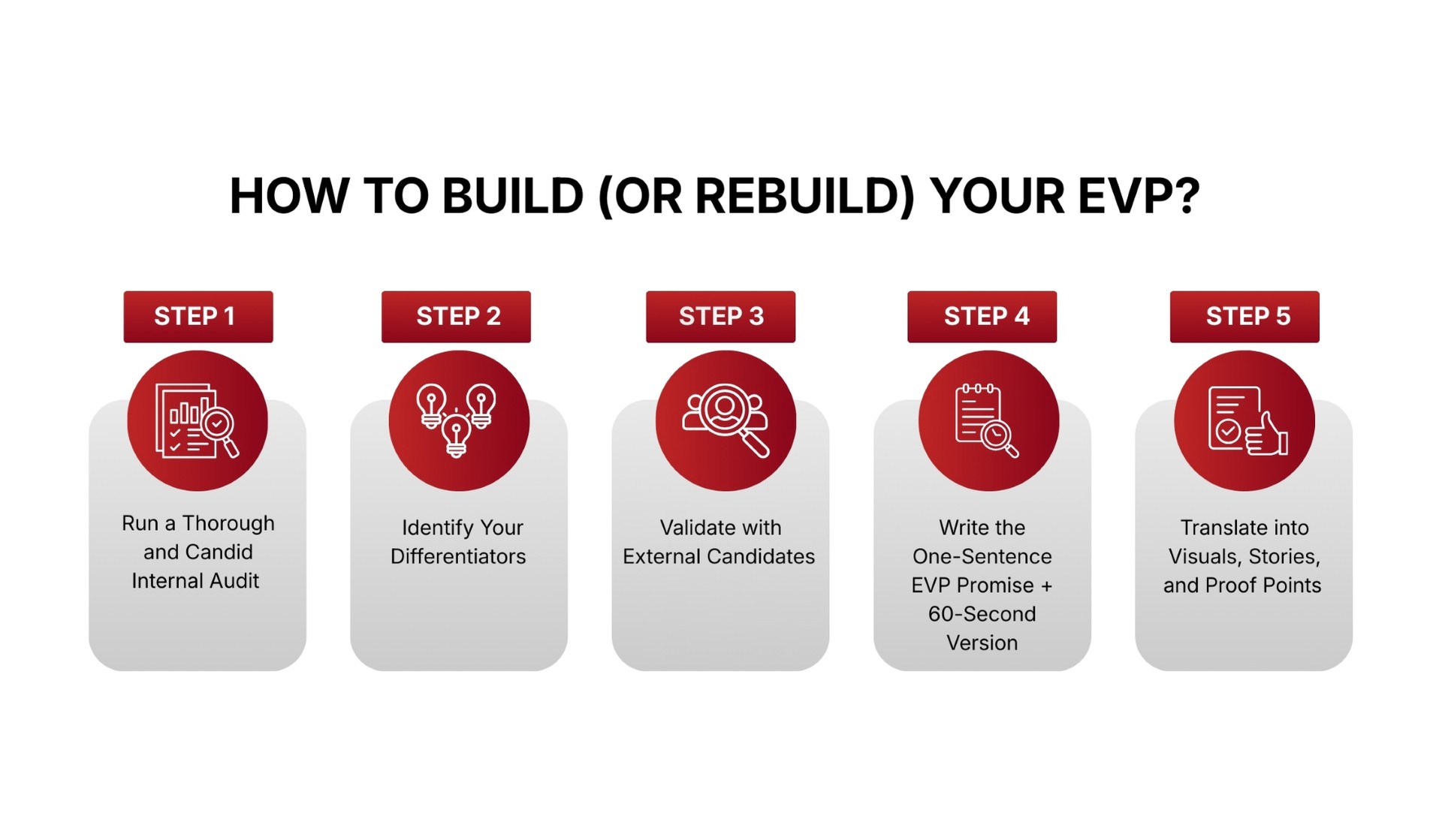
Start by gathering comprehensive data from your current workforce. Employee surveys should explore satisfaction drivers, frustration points, and what genuinely differentiates your organization from previous employers.
Focus groups provide qualitative depth that surveys miss. Facilitate open conversations about what employees value, what they tolerate, and what they wish would change. Create psychological safety for honest feedback by emphasizing that you seek truth rather than validation.
Exit interview mining reveals why talent leaves. Analyze patterns across departure conversations, looking for recurring themes around unmet expectations, cultural misalignment, or better opportunities elsewhere. Former employees often provide the most candid feedback about organizational realities.
Stay interviews with high performers identify retention factors. Understanding what keeps your best people engaged reveals strengths to amplify in your EVP positioning.
Synthesize research findings to pinpoint the 3-5 elements where you genuinely excel. Resist the temptation to claim excellence across all dimensions. Specificity creates credibility while generic claims breed skepticism.
Ask yourself:
Your differentiators might relate to mission impact, technical challenges, cultural dynamics, growth velocity, or work flexibility. What matters is authenticity. You must be able to deliver consistently on these promises.
Internal perspectives require external validation. Conduct blind surveys with professionals in your talent pools, asking what they seek in employers and how they perceive your organization.
Analyze Glassdoor reviews and Reddit discussions about your company. These unfiltered perspectives reveal whether your intended EVP aligns with external perceptions. Address significant disconnects before launching new positioning.
Interview candidates who declined offers to understand decision factors. Often, the gap between your positioning and their experience during recruitment reveals EVP weaknesses requiring attention.
Distill your research into a concise core statement capturing what you offer employees. This sentence should be:
Expand this core statement into a 60-second narrative explaining the employee's experience, growth opportunities, cultural elements, and impact potential. This version serves as the foundation for all EVP communications.
Abstract promises require concrete evidence. Develop materials that bring your EVP to life through multiple formats:
Strong EVPs combine words, images, and stories into cohesive narratives that candidates can envision themselves joining.
An EVP only delivers value when effectively deployed across every candidate interaction. Strategic embedding ensures consistent messaging while allowing authentic expression.
Your career website should immersively communicate EVP elements through design, content, and functionality. Move beyond listing benefits to showing what employees experience daily. Feature authentic voices, real workspaces, and tangible outcomes.
Job descriptions require EVP integration beyond standard role requirements. Explain why the position matters, how it connects to organizational mission, and what growth pathways it enables. Each posting should make candidates envision themselves contributing meaningfully.
Recruiter scripts and email templates should consistently reference EVP themes. When every interaction reinforces core messages, candidates develop a clear understanding of what you offer and whether it aligns with their priorities.
Offer letters present opportunities to reiterate EVP promises. Beyond compensation details, emphasize growth support, cultural fit, and the impact they'll enable. This final touchpoint shapes initial employment expectations.
Candidates trust evidence over assertions. Organizations that demonstrate EVP elements through tangible examples build credibility that generic claims cannot achieve.
Employee stories provide perspectives that marketing copy lacks. Feature diverse voices across roles, tenures, and backgrounds discussing their experiences, challenges, and growth. These narratives help candidates self-assess cultural fit.
Day-in-the-life videos transport candidates into actual work environments. Show real meetings, collaboration dynamics, and problem-solving processes rather than staged interactions. Authenticity matters more than polish.
Live Q&A sessions with current employees allow unscripted conversations. When candidates can ask questions directly to team members without HR mediation, they gain confidence in organizational transparency.
A clearly articulated EVP helps candidates self-select based on alignment. This pre-qualification improves offer acceptance rates and early retention by ensuring cultural and expectational fit before extensive investment in recruitment processes.
Be explicit about your differentiators and trade-offs. If you offer exceptional growth opportunities within demanding environments, state this clearly. Candidates seeking work-life balance will self-select out while those excited by challenge will lean in.
When candidates understand what you genuinely offer versus what you don't prioritize, they make informed decisions that reduce regret and early turnover.
Many organizations undermine their talent attraction efforts through predictable missteps. Avoiding these pitfalls strengthens EVP effectiveness substantially.
Phrases like "great culture," "fast-paced environment," "work hard, play hard," or "like a family" have lost all meaning through overuse. These vague descriptors apply to virtually any organization, providing candidates no useful information about your specific environment.
Replace generic language with concrete examples. Instead of claiming "great culture," describe how employees collaborate, what behaviors get recognized, and how conflicts get resolved. Specificity builds credibility.
The gap between EVP promises and employee realities creates toxic cycles. New hires who discover misalignment between recruiting messages and actual experiences feel deceived, leading to early departures and negative reviews that damage future recruiting.
Promise only what you consistently deliver. If your EVP emphasizes work-life balance, ensure managers support reasonable boundaries rather than expecting constant availability. Misalignment between stated values and lived experiences destroys trust.
Candidates research organizations extensively before applying. Ignoring critical reviews or dismissing them as outliers while contradictory evidence accumulates signals organizational denial.
Address substantive criticism directly. If reviews consistently mention poor management or limited growth opportunities, these issues require resolution before EVP positioning will resonate. Fixing underlying problems proves more effective than crafting better marketing messages.
Different employee populations value different aspects of employment experience. Early-career professionals prioritize growth and learning while experienced executives seek autonomy and impact. Technical talent values intellectual challenges while operations teams emphasize stability and support.
Consider segment-specific EVP emphasis while maintaining core authenticity. Your foundational promises remain consistent, but messaging highlights elements most relevant to specific audiences.
By tailoring your EVP communication to resonate with diverse talent segments while preserving authenticity, you create a powerful strategic tool that drives sustainable competitive advantage in talent acquisition.
The employee value proposition represents far more than recruitment marketing. When developed authentically through comprehensive research, structured thoughtfully around genuine organizational differentiators, communicated consistently across channels, and measured rigorously for effectiveness, the EVP becomes a strategic asset that transforms talent acquisition outcomes.
Organizations that invest in building compelling EVPs position themselves to attract candidates who align with their culture and values, reduce costly turnover, and build sustainable competitive advantages through superior talent. In markets where qualified candidates remain scarce and employee expectations continue evolving, the strategic EVP provides the foundation for long-term talent acquisition success.
The development process requires collaboration across HR, leadership, and existing employees to ensure authenticity and alignment. The ongoing management demands measurement discipline and willingness to adapt as circumstances change. However, organizations that commit to this strategic approach will find themselves better positioned to secure the talent necessary for sustained growth and competitive success.
This website uses cookies to enhance website functionalities and improve your online experience. By browsing this website, you agree to the use of cookies as outlined in our privacy policy .