Your best performers already know what skills they need to grow. If they cannot develop those skills within your organization, they begin seeking opportunities elsewhere. The challenge most managers face is the absence of a structured approach to growing them in ways that serve both individual ambition and business direction.
A talent development strategy deliberately builds employee capabilities aligned with business goals through skills assessment, personalized planning, diverse learning methods, and measurable outcomes. According to ClearCo, retention is 34% higher among employees who have opportunities for professional development, and companies are 17% more productive when employees receive the training they need. These show up in reduced attrition costs, faster project delivery, and teams that can absorb change without falling apart.
Talent management and talent development are closely related but serve different purposes. Talent management is the broader system that oversees the entire employee journey, while talent development focuses specifically on growing people’s skills and capabilities.
These two terms are often used as if they mean the same thing, which leads to confusion about who owns what and what actually needs to happen. Talent management covers the full employee lifecycle: recruitment, onboarding, performance reviews, and succession planning. It is broad and largely process-driven. Talent development zooms in specifically on growth: closing skill gaps, building capability, and creating pathways for progression.
Think of talent management as the system and talent development as the momentum that keeps people moving through it. An organization can have robust hiring and retention processes and still watch performance stagnate if it is not actively developing the people inside those processes. The two need to work together, but development is what most managers have the most direct influence over, and it is where the most immediate impact on team performance tends to live.
In simple terms: talent management builds the structure, while talent development drives growth within that structure.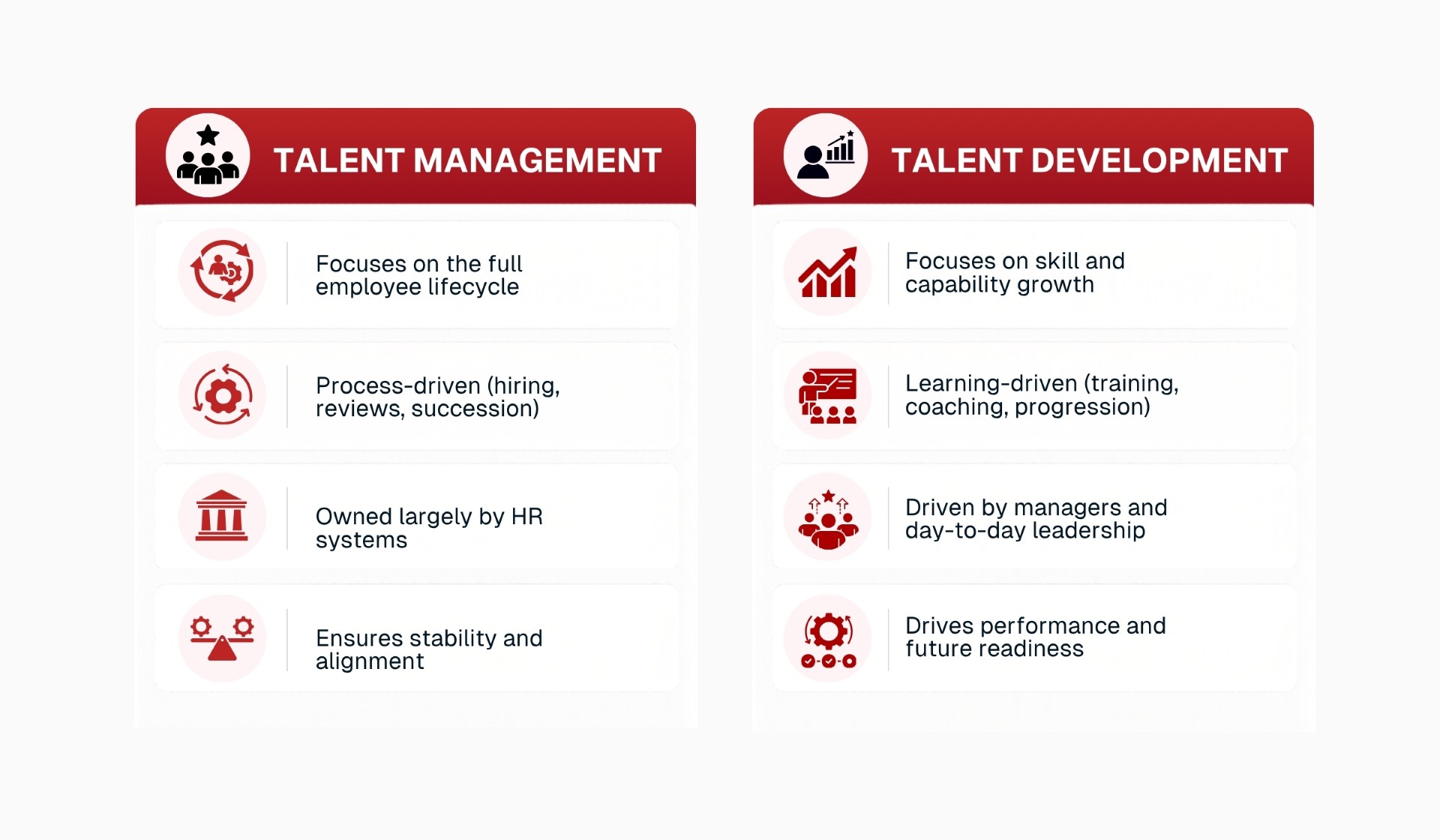
Most managers are not failing at talent development because they do not care about it. They are failing because the conditions in which they operate make it genuinely difficult. According to Thomas, turnover rates currently sit at around 13% overall, rising to 26.7% in retail and wholesale, and 88% of organizations are concerned about employee retention. These pressures create a counterproductive cycle: the more stretched a team becomes, the less time managers feel they have for development conversations, which makes the retention problem worse.
Three specific challenges tend to derail development efforts before they gain traction.
Building a talent development strategy does not require redesigning your entire approach to management. It requires a repeatable process that you can apply consistently, regardless of team size or industry.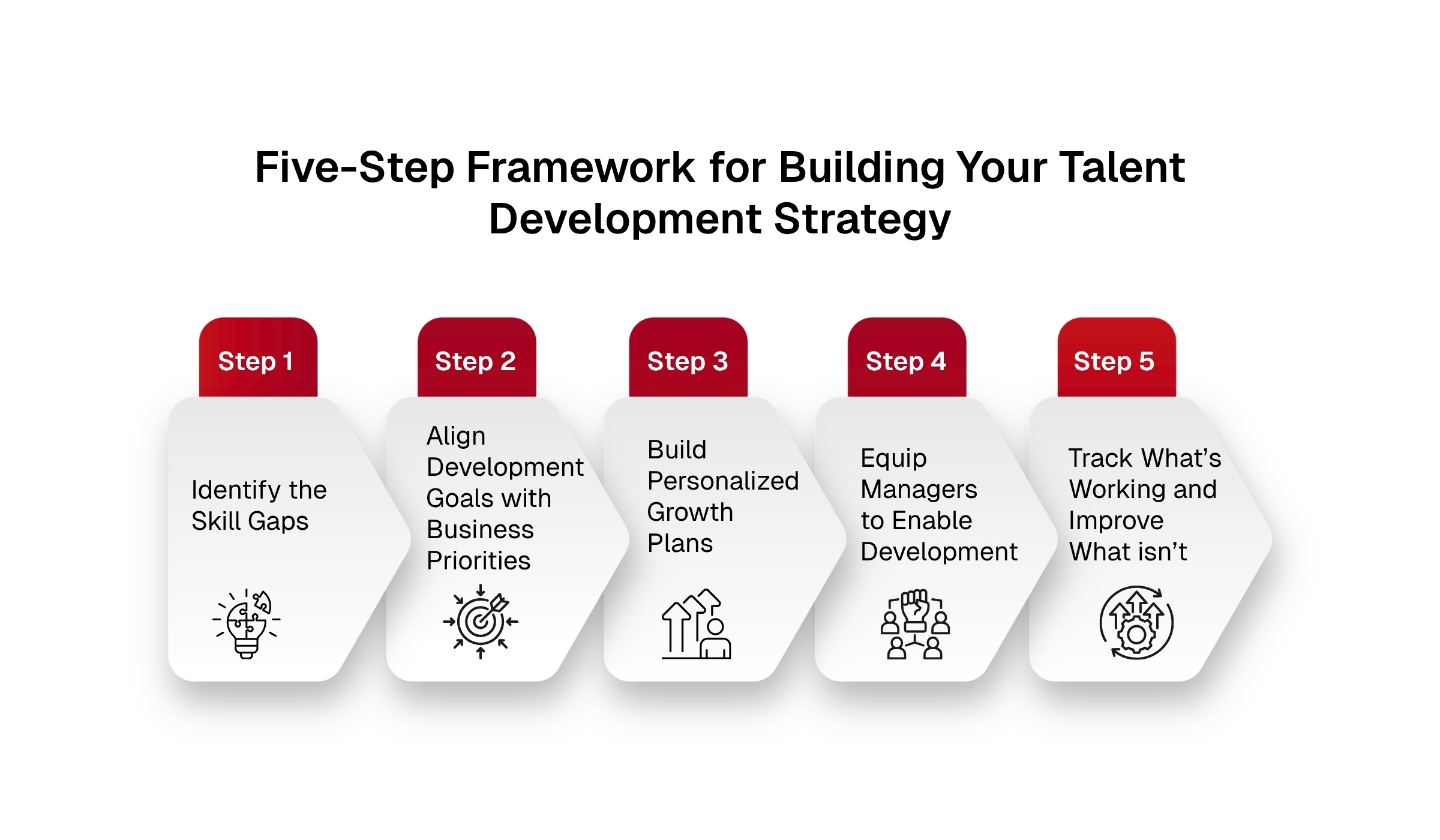
Before designing any development plans, you need an honest picture of where your team currently stands. This goes beyond formal performance reviews. Ask team members which parts of their role feel most challenging, whether their strengths are being fully used, and what they would like their next step in the company to look like.
Combine self-assessments and direct conversations with tools like psychometric assessments, which surface behavioral traits and aptitude levels that standard reviews tend to miss. Tools like Thomas assessments map personality traits, natural strengths, and potential derailers directly to development paths, giving managers objective data alongside qualitative feedback.
For each team member, map their top responsibilities to business outcomes, identify where they are underperforming or at risk of burnout, and determine which skill improvements would unlock the most performance. Then reverse-engineer development goals from that analysis. A key account manager struggling with cross-selling needs product fluency and negotiation skills. A technical lead moving into people management needs coaching and delegation practice.
Every development plan should be traceable back to a team with KPI, OKR, or department-level outcome. When growth plans connect to real business needs, employees see the point and managers can demonstrate tangible returns.
Generic development plans produce generic results. A personalized growth plan, co-created with the employee, should include two to four specific goals per quarter with clear success criteria, a mix of learning methods, and monthly check-ins to maintain visibility and catch problems early. The 70-20-10 framework offers a useful structure: 70% of development through experiential learning such as stretch assignments and new responsibilities, 20% through social learning including coaching and peer feedback, and 10% through formal training that fills specific knowledge gaps.
Organizations balancing all three elements see stronger skill transfer than those relying mainly on classroom instruction. Experiential learning ensures employees learn by doing, not merely consuming content
A development strategy will stall if the managers responsible for delivering it lack the capability to do so effectively. Leadership development for managers needs to include coaching skills, active listening, and growth-oriented feedback, skills that allow managers to move beyond vague encouragement and into real developmental conversations.
For global and distributed teams, cross-cultural communication capability is equally important. When managers cannot communicate clearly across cultures and time zones, projects stall, misunderstandings compound, and talented employees in non-dominant regions miss out on growth opportunities they deserve.
If you are not measuring your development efforts, you are guessing. Track three to five metrics quarterly: IDP completion rate (aim for 80% or above), the percentage of open positions filled internally (a healthy target sits between 30% and 40%), and whether developed employees stay longer than those without structured development plans.
Ask your team directly whether the development activity is helping them grow. What works for one cohort may need to adjust for the next, and building a feedback loop into your strategy is what allows it to improve rather than plateau.
A strong employee development strategy draws on a mix of methods rather than relying on any single approach. The most effective options tend to be:
For organizations running distributed or global teams, business English and cross-cultural communication training belongs in this list. ZIM International found that after addressing communication barriers through structured training, 92% of employees reported productivity increases and 89% gained confidence working with international peers. Teams that had been polite but operationally distant began collaborating effectively, and employees who had avoided leadership opportunities due to language confidence gaps started raising their hands for management roles.
Real-world examples illustrate what this approach produces when applied consistently. Medela, a medical vacuum technology company, introduced psychometric assessments into their hiring and development process after identifying a lack of diversity in their talent pipeline. By using structured assessments to compare candidates and team members objectively, they improved collaboration and productivity within teams in ways that informal evaluation had not achieved.
FactSet Research Systems took a similar approach to identifying internal leadership potential, with over 95% of senior executives completing a high-potential assessment. Talent management at FactSet is now described as significantly more robust because of the additional behavioral data available to inform decisions. Crown Holdings applied aptitude assessments to their graduate development program, reducing the time spent reviewing applications while improving the match between candidate potential and program demands, all without introducing unconscious bias into the selection process.
A talent development strategy does not require a large budget or an HR overhaul to deliver results. It requires clarity about where the business is going, honest assessment of where your team currently stands, personalized plans that connect individual growth to real business outcomes, and a consistent feedback loop to measure and adjust. When managers treat development as part of their weekly rhythm rather than an annual event, the returns accumulate: stronger retention, faster internal promotion, higher engagement, and teams capable of absorbing change without losing momentum.
The organizations that grow the best people are the ones that make development a leadership function, not just an HR one. Start with one team, one skills audit, and one quarter of structured development plans. The results will make the case for everything that follows.
Q. What is a talent development strategy?
A. A talent development strategy is a structured plan for building employee skills and capabilities in alignment with business goals. It combines skills assessment, personalized development planning, varied learning methods, and progress measurement to grow capability systematically rather than through scattered, ad hoc training.
Q. How do managers build high-performing teams?
A. Managers build high-performing teams by clearly understanding current skill levels, aligning individual growth goals with business priorities, creating personalized development plans with regular check-ins, and mixing experiential, social, and formal learning methods. Consistency in coaching conversations and a genuine investment in each person's progression are what separate average managers from those whose teams consistently deliver.
Q. What are examples of development strategies?
A. Practical examples include stretch assignments that push employees into new responsibilities, mentorship programs pairing junior staff with experienced colleagues, job rotations that build cross-functional understanding, one-on-one coaching focused on specific leadership skills, formal training programs for foundational technical knowledge, and psychometric assessments that guide personalized development planning.
Q. Why is employee development important?
A. Employee development directly improves retention, productivity, and organizational resilience. When employees see a credible path for growth inside an organization, they are more engaged, more committed, and less likely to look elsewhere. For the business, internal development reduces the cost and disruption of external hiring, builds a pipeline of capable leaders, and creates a culture where continuous learning becomes the norm rather than the exception.
This website uses cookies to enhance website functionalities and improve your online experience. By browsing this website, you agree to the use of cookies as outlined in our privacy policy .