Most HR leaders know their technology investments deliver value. The problem? They can't prove it. 51% cannot measure the return on investment of their technology investments, according to Gartner research. This creates a cycle: without demonstrating value, securing budget approval becomes harder, and without investment, proving value remains impossible.
The challenge intensifies small and mid-sized businesses. 64% allocate less than 1% of annual revenue to HR technology, and 36% use virtually no HR tech at all. These organizations face intense pressure to justify every dollar spent, yet they lack the resources that larger companies deploy for sophisticated analytics.
Economic conditions compound the problem. Companies operate in austerity mode, asking HR to do more with less. Meanwhile, two out of three HR leaders believe their function's effectiveness will decrease if they don't improve their approach to technology.
Breaking this cycle requires reframing how HR leaders' approach, measure, and communicate the value of technology investments.
Most finance teams use a simple formula: subtract costs from benefits, divide by costs, multiply by 100. The math works fine. The real challenge lies in identifying and quantifying benefits that actually matter to business leaders.
HR technology delivers value through multiple channels. Some are direct and measurable, like reduced payroll processing costs or fewer recruiting fees. Others are indirect, like improved employee experience leading to higher retention. Still others are strategic, like better workforce planning enabling faster response to market changes.
Only 35% of HR leaders feel confident their current approach to HR tech helps achieve business objectives. This lack of confidence stems partly from focusing on the wrong metrics. Measuring implementation progress or feature adoption misses the point. Business leaders care about outcomes that affect performance, costs, or revenue.
Common obstacles prevent HR leaders from demonstrating value effectively:
Overcoming these barriers requires a structured approach that balances measurable financial returns with strategic business value.
A comprehensive evaluation approach combines three complementary methods that together provide a complete picture of value.
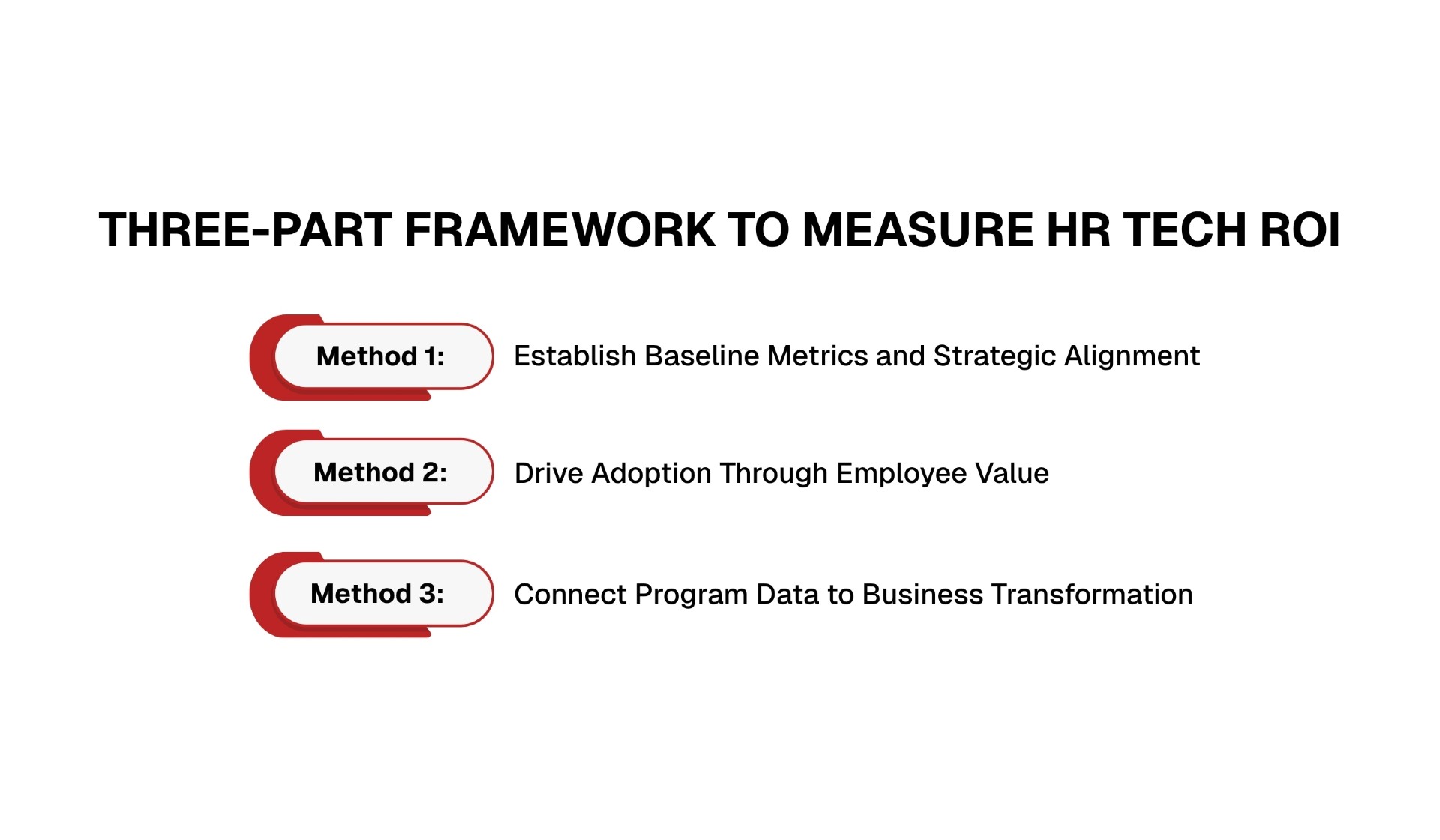
Begin by working with stakeholders to define value in terms they understand. CFOs care about cost reduction and resource efficiency. COOs focus on operational improvements and productivity. CEOs want revenue impact and market positioning.
Connect HR tech solutions to these priorities. If human capital accounts for approximately 54% of total business costs, tracking compensation, recruitment, performance, and training metrics drives better workforce management and cost control.
Document current state metrics before implementation:
These baselines enable before-and-after comparisons, showing actual impact rather than projected benefits.
Only 24% of HR employees say their function gets maximum value from HR tech. Maximizing ROI requires treating HR tech as business tech, embedding it into how people work, collaborate, and lead at every level.
The challenge: 67% of organizations adopt new technology without transforming how employees work. This creates friction. 69% of employees reported at least one barrier when using HR tech in the past year.
Show value to employees by focusing on what they need most. Does technology save them time? Reduce frustration? Provide helpful information when they need it? Employee adoption generates data that demonstrates business value.
High adoption in one department provides good data. Broad adoption across the organization provides great data by revealing cross-functional impact.
Correlate program-level data to business goals like productivity, safety, customer service, or quality control. Benchmark against internal data and track over time for actionable insights.
One airline discovered closing plane doors five minutes earlier could save millions. Standard procedures existed, but documentation didn't drive behavior to change. Using recognition software to reward employees who closed doors early made the impact tangible. The airline's bottom line grew by millions, and the recognition platform demonstrated clear ROI by connecting employee behavior to financial outcomes.
Having defined the evaluation framework, let's examine how to quantify the specific types of value HR technology creates. Effective measurement captures each distinct category of benefit, from immediate cost savings to long-term strategic impact.
Quantifying value matters, but convincing decision-makers requires presenting that value in formats they trust and understand. The following strategies help translate your measurements into compelling business cases.
Organizations that make data-driven decisions are 63% more likely to adapt to changing business environments, according to McKinsey. HR leaders who have the right data are five times more likely to make strategic recommendations.
CFOs and CEOs typically want to see risk reduction metrics showing how technology prevents costly problems like compliance violations and workplace safety incidents. They want revenue correlation demonstrating connections between HR outcomes and business performance. Research from Great Place to Work shows that prioritizing employee experience can lead to 50% less turnover and 36% higher discretionary effort. That effort translates to better customer service, higher quality, and increased innovation.
They also want operational efficiency improvements showing how HR tech enables faster business moves. Reducing time to fill positions from 60 to 30 days means projects start sooner and opportunities don't get missed.
Here's how to structure your implementation for maximum measurable impact.
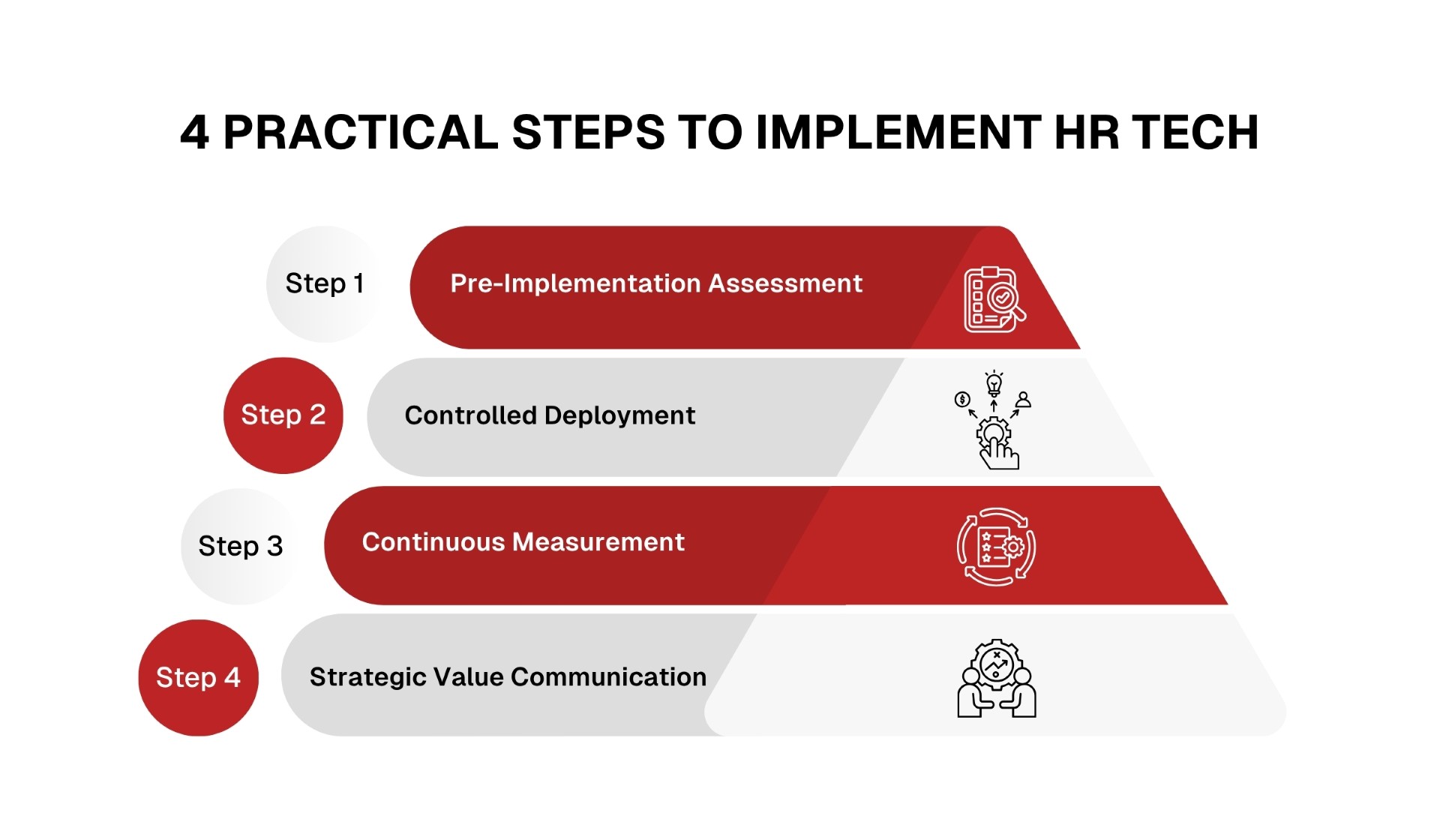
Document your current state before implementation. This baseline becomes the foundation for measuring improvement. Calculate how much time HR staff currently spend on manual tasks like data entry, report generation, or answering routine employee questions. Track current costs for recruitment, onboarding, compliance management, and employee turnover.
Work with stakeholders to define what success looks like. CFOs might prioritize cost reduction. Operations leaders may focus on time savings. Business unit heads often care most about how HR tech affects their team's productivity. Get specific commitments on which metrics will determine whether the investment succeeded.
Establish data collection processes before implementation begins. Identify which systems will provide data, who will be responsible for tracking metrics, and how frequently measurements will occur. Without this infrastructure in place, proving value later becomes nearly impossible.
Resist the temptation to roll out new technology across the entire organization immediately. Instead, pilot with a department or team where conditions favor success. Look for groups with supportive leadership, tech-savvy employees, or acute pain points the technology will address.
This pilot serves multiple purposes. It generates early data on adoption rates, usage patterns, and initial business impact. It reveals implementation challenges before they affect the whole company. It creates internal champions who can share positive experiences with colleagues. Most importantly, it provides concrete evidence of value before requesting a budget for broader deployment.
During the pilot, track both quantitative metrics and qualitative feedback. Monitor how many employees actively use the system, which features get adopted quickly, and where users struggle. Gather stories about how technology helped solve specific problems or enabled new capabilities.
Once deployed, establish regular measurement cadences. Monthly or quarterly reviews catch problems early while demonstrating ongoing value to stakeholders. Compare actual results against the projected benefits you used to justify the investment.
When reality falls short of expectations, investigate root causes. Is the technology underperforming, or are adoption barriers preventing people from using it effectively? Are the metrics you're tracking actually meaningful, or do you need different measurements to capture the real value being created?
Apply these insights to refine your approach. If employees struggle with certain features, provide additional training. If adoption lags in specific departments, work with leaders to address barriers. If some benefits take longer to materialize than expected, revise timelines and communicate why.
This continuous improvement approach ensures you maximize the return on your technology investment rather than treating implementation as a one-time event.
Measuring value means nothing if stakeholders don't understand what you've achieved. Translate your data into formats that resonate with different audiences. CFOs want financial analysis showing cost savings and ROI calculations. Operations leaders want efficiency metrics demonstrating process improvements. Business unit heads want to understand how HR tech supports their team's performance.
Create regular reporting that highlights progress against established success metrics. Use dashboards for quick visual updates and detailed reports for quarterly business reviews. Adjust the level of detail and technical complexity based on your audience.
Pair quantitative data with compelling storytelling. Numbers prove value, but stories make it memorable and relatable. Share specific examples of how the technology helped employees, solved problems, or enabled new capabilities. A story about how automated onboarding helped a new hire contribute value three weeks faster resonates more than abstract productivity statistics.
Acknowledge successes openly while transparently addressing challenges. This builds credibility and demonstrates that you're managing the investment responsibly rather than just promoting a pet project.
Addressing disengagement can yield up to $56 million in annual savings even for mid-sized organizations. The principles scale proportionally for smaller businesses.
Reframe HR technology as a strategic enabler showing how unified platforms reduce burden, alleviate compliance risk, and free time for high-value work. Use workforce analytics revealing patterns in turnover and productivity correlating with performance. Advocate for integrated platforms removing silos and enabling proactive planning.
Proving HR technology ROI requires shifting from measuring activity to demonstrating business impact.
Start by aligning technology investments with specific business objectives. Build measurement into implementation plans. Drive adoption by showing employees how technology makes their work better. Connect program data to business outcomes that matter to decision-makers.
ROI isn't just about justifying past investments. It's about building credibility that enables future investments in people and capabilities that drive sustained business success. HR leaders who can prove ROl don't just secure budget, they shape business decisions.
This website uses cookies to enhance website functionalities and improve your online experience. By browsing this website, you agree to the use of cookies as outlined in our privacy policy .





.png)